
Most businesses in Bangladesh that tell me their Facebook ads “stopped working” are not running bad ads. They are measuring the wrong thing. The ads manager says cost per message is Tk 15 and everyone is happy, while the courier statement at the end of the month tells a very different story.
This guide is for founders, business owners and marketing heads who spend serious money on Meta Ads (Facebook and Instagram) and want that spend to show up as profit, not just activity. It covers why Meta Ads underperform in the Bangladeshi market specifically, the one metric that fixes most of the confusion, and what a sound setup looks like now that Meta’s automation runs most of the campaign.
The short answer
Meta Ads lose money in Bangladesh for three recurring reasons: campaigns are optimised for cheap messages instead of real sales, cash-on-delivery returns are left out of the cost calculation, and Meta’s algorithm is never told which orders actually got delivered and paid. Fix the measurement first. Targeting tricks and new creatives come after.
Why Bangladesh is a different Meta Ads market
The reach is real. NapoleonCat’s tracking of Meta’s advertising audience put Facebook users in Bangladesh at roughly 72 million in September 2026, around 40% of the population, with 18 to 24-year-olds the largest age group and men making up a little over 60% of the audience (NapoleonCat). For most consumer brands, no other channel comes close.
But the buying journey here does not look like the one Meta’s tools were designed around. Four local realities change the maths:
- Cash on delivery still dominates. Payments research firm PCMI estimates that around three quarters of Bangladesh’s e-commerce volume is paid by cash on delivery, with digital wallets a distant second (PCMI). An order is a promise, not a sale.
- Returns are expensive and common. Logistics provider Paperfly has publicly put returns at close to a quarter of online orders (banglanews24). Every refused parcel costs you delivery, return handling and often damaged packaging.
- The sale happens in the inbox. A large share of Bangladeshi commerce runs through Messenger and WhatsApp conversations, so the person replying to messages is part of your ad performance whether you treat them that way or not.
- Your ad cost is higher than the Ads Manager shows. Banks are instructed to deduct 15% VAT on card payments to platforms such as Facebook and Google (Eastern Bank notice), and card exchange rates add their own margin. Check your card statement, not just the ads dashboard.
The metric that changes the conversation: cost per delivered order
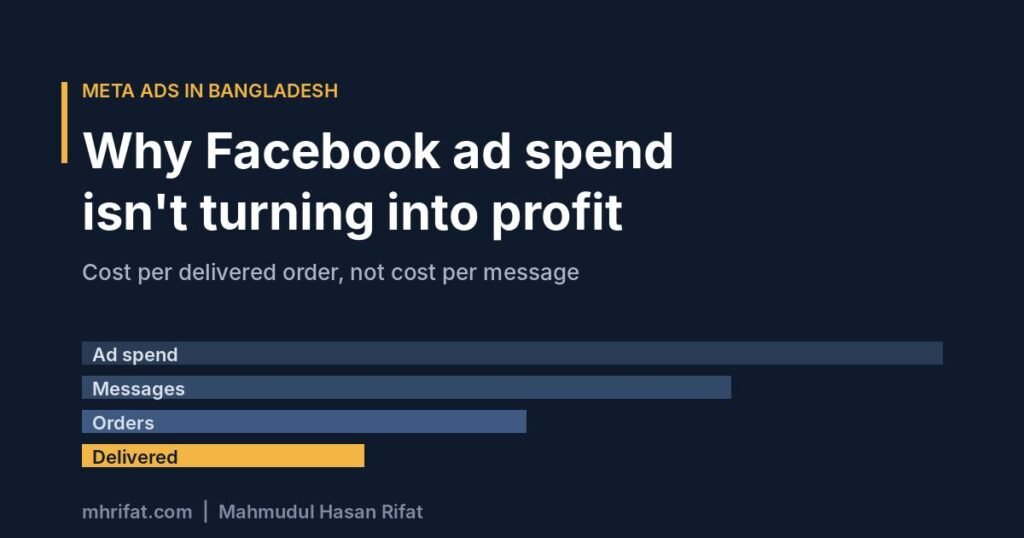
Cost per message, cost per lead and even cost per purchase all stop short of the point where money actually reaches your account. In a COD market, the honest number is cost per delivered order: total ad cost, including VAT and card charges, divided by orders that were delivered and paid.
Here is an illustrative example. The figures are hypothetical, chosen only to show how the gap opens up.
| Stage | What the business sees | Effective cost |
|---|---|---|
| Ad spend in ads manager | Tk 50,000 | Tk 50,000 |
| Actual card charge (with 15% VAT) | Tk 57,500 | Tk 57,500 |
| Messages received | 2,500 | Tk 23 per message |
| Confirmed orders | 400 | Tk 144 per order |
| Delivered and paid (75%) | 300 | Tk 192 per delivered order |
The ads manager celebrates a Tk 20 message. The business is really paying close to Tk 200 for each sale that reaches its bank account, before counting the delivery and return fees on the 100 parcels that came back. If your gross margin per order is Tk 250, that campaign is barely breaking even. If it is Tk 180, every “successful” day loses money.
Once this number sits on a weekly sheet next to margin per order, most budget decisions make themselves.
Five reasons Meta Ads lose money for Bangladeshi businesses
1. Optimising for the cheapest action, not the most valuable one
Meta delivers exactly what you ask for. Ask for messages, and it finds people who send messages, including the curious, the price-checkers and the ones who never reply after “price koto?”. Message campaigns are not wrong, but they need a feedback loop that tells you which messages became paid orders. Without it, the algorithm keeps buying more of the cheapest, lowest-intent conversations.
2. Leaving COD returns out of the calculation
Returns are usually treated as an operations problem. They are also a targeting and creative problem. Ads that promise too much, hide the price or attract impulse buyers create more refusals at the door. Track return rate by campaign and by creative, not only by courier. The ad with the lowest cost per order is sometimes the one with the worst delivery rate.
3. Meta never learns which orders were real
If your only signal is a browser pixel or a message count, Meta optimises toward the wrong people. Sending server-side events through Meta’s Conversions API, ideally including a confirmed or delivered order event uploaded from your order system, gives the algorithm a far better picture of who actually buys. For businesses selling mostly through the inbox, even a disciplined weekly upload of delivered orders is a big step up from nothing.
4. Fighting the algorithm instead of feeding it
Advantage+ automation is now the default for sales, leads and app campaigns, and Meta has steadily reduced manual targeting controls. Splitting a small budget into a dozen interest-based ad sets mostly fragments learning. In 2026, creative does most of the targeting: different angles, formats and offers reach different buyers. Meta’s own published claims of better ROAS from Advantage+ are vendor benchmarks, not a promise for your account, so judge the change against your delivered orders, not the dashboard.
5. The inbox is where the money leaks
A message answered in two minutes and a message answered in two hours are not the same lead. Slow replies, inconsistent pricing answers and no follow-up on unconfirmed orders quietly destroy campaigns that were working. Before raising the budget, check reply time during ad hours, whether staff use a clear script for price, delivery charge and return policy, and whether someone confirms orders by phone before dispatch.
What a sound Meta Ads setup looks like in 2026
- One clear business metric: cost per delivered order (or cost per qualified lead for B2B, real estate and education), reviewed weekly against margin.
- Clean data flowing back to Meta: pixel plus Conversions API, with confirmed or delivered orders sent as events where possible.
- Simple structure: fewer campaigns with enough budget to exit learning, rather than many starved ad sets. Give changes at least a week before judging them.
- A creative pipeline, not a single hero ad: several genuinely different concepts each month, covering price, proof, product demonstration and objections such as delivery time or return policy.
- Price and delivery terms stated upfront: it raises cost per message slightly and usually lowers refusals at the door.
- Partial advance payment for higher-value items: a small bKash or Nagad deposit filters out non-serious buyers before you pay for delivery.
- An inbox standard: reply-time targets, saved replies and phone confirmation, treated as part of the campaign.
When Meta Ads are the wrong channel
Meta is a demand-creation channel. It is excellent at putting a product in front of people who were not looking for it. It is weaker when buyers already know what they want and go searching. A buyer looking for a specific laptop model, an IELTS centre or a hospital service is often better reached through Google Search ads and organic search. Many businesses here run only Facebook because it feels familiar, and leave high-intent search demand to competitors. If that sounds like your business, read my guide on working with an SEO consultant in Bangladesh alongside this one.
For B2B, real estate and education, the right Meta objective is usually a qualified lead with a proper follow-up process, not a cheap message. I cover those sectors in more depth in the guides for real estate marketing and EdTech student acquisition.
Questions to ask before hiring a Meta Ads consultant or agency
Whoever manages your ads, these questions separate strategic partners from button-pushers:
- Which number will you report to me every week, and does it include returns?
- How will delivered or qualified results be sent back to Meta?
- Who owns the ad account, pixel and business manager? (The answer should be you.)
- How many new creative concepts will we test each month, and who produces them?
- What would make you recommend spending less on Meta, not more?
The last question matters most. A consultant who only ever recommends a bigger budget is selling spend, not growth. My broader view on evaluating marketing partners is in the guide to hiring a social media marketing professional in Bangladesh.
Working with me
I am Mahmudul Hasan Rifat, a Bangladesh-based digital marketing consultant with more than six years in performance marketing, SEO and social media advertising, and Meta and Google certifications. I work with e-commerce, education, SaaS and service businesses in Bangladesh, the UK and Australia. I also run a retail business in Cumilla, so COD returns and inbox selling are problems I deal with first-hand, not just in client reports.
If your Meta Ads spend is growing faster than your delivered orders, a focused account and measurement review is usually the fastest way to find where the money is going. Learn more about my background or get in touch to discuss your account.