

An SEO consultant from Bangladesh helps a business earn qualified search traffic and convert it into revenue by fixing technical barriers that stop Google from crawling and understanding a site, researching the actual demand behind a market, building content that answers real buyer questions, earning credible links and citations, and measuring the outcome against business goals rather than rankings alone. The difference between a consultant and a service vendor is accountability: a consultant starts with the commercial problem, not with a package of deliverables.
This article explains how I approach search engine optimization, the framework I run, what it costs and why, how to evaluate any SEO consultant before you hire, and what search optimisation genuinely cannot do for you. It is written for business owners, founders, marketing managers and overseas companies considering working with a consultant based in Bangladesh.
About the SEO Consultant from Bangladesh
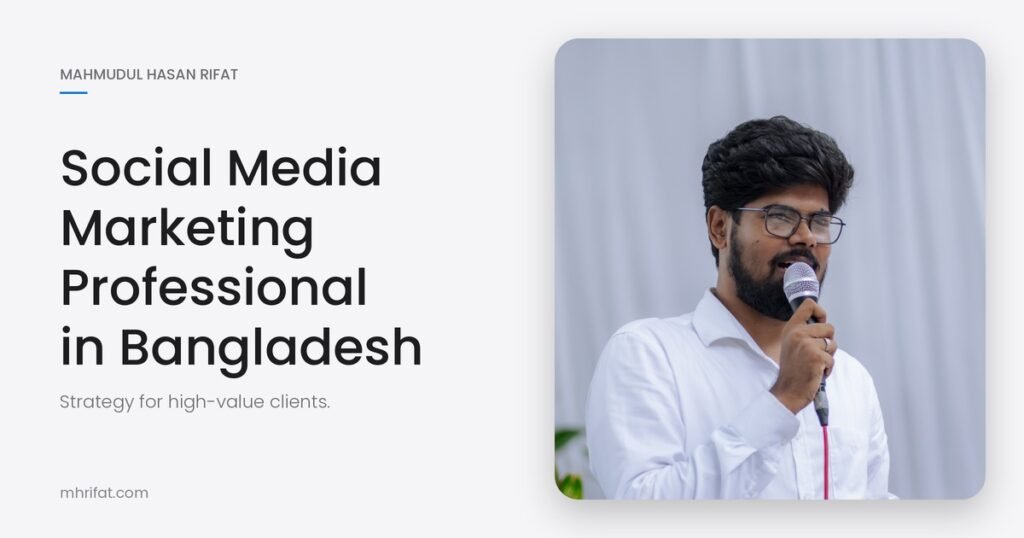
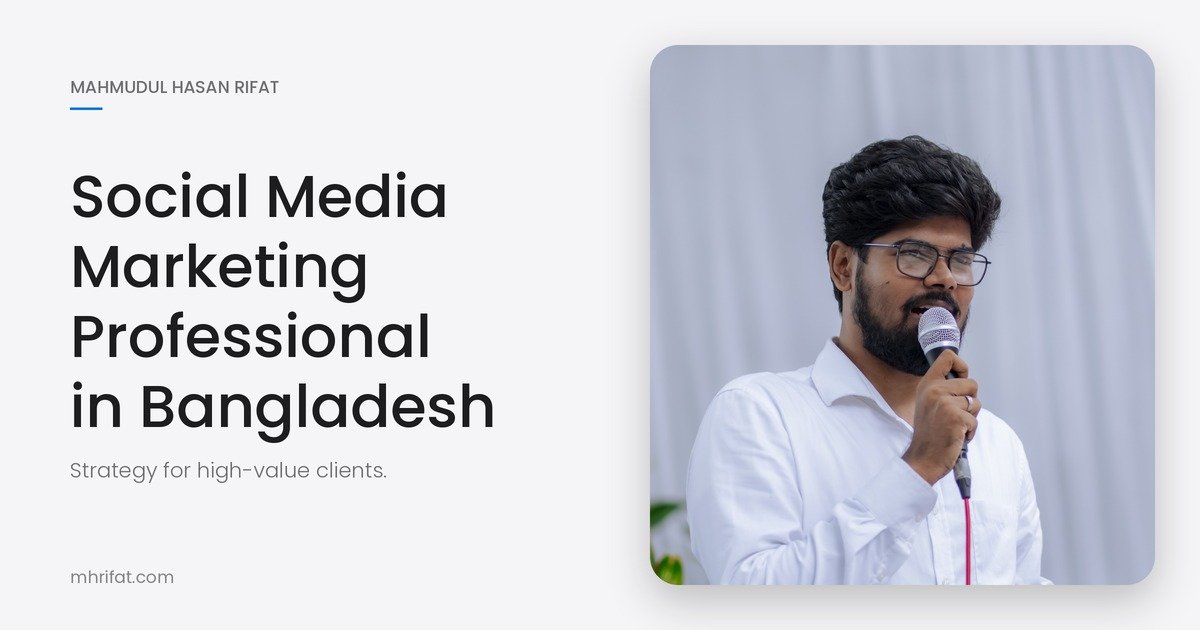
I am Mahmudul Hasan Rifat, an SEO and digital marketing consultant based in Bangladesh with more than six years of experience. I work across search engine optimization, search demand analysis, competitor research, answer engine optimisation, digital customer acquisition, performance marketing and content strategy.
My work spans Bangladeshi, UK and Australian markets, most often in international education, technology, e-commerce and professional services. I hold certifications from Google, Meta, HubSpot, SEMrush and others, and I serve as Community Manager for the Cumilla Freelancing Community, where I mentor freelancers entering digital marketing.
How I prefer to work: diagnosis before proposal, a written roadmap you own regardless of what happens next, execution or precise direction depending on your internal capacity, and reporting that connects to enquiries and revenue rather than vanity metrics. Where a problem sits outside my scope, I will say so rather than sell into it.
Professional Profile at a Glance
Name: Mahmudul Hasan Rifat
Location: Bangladesh
Profession: AI Digital Marketing Manager, Growth Consultant and Entrepreneur
Experience: SEO, AEO, Paid Media(Google Ads, Meta Ads, X Ads), Performance Marketing, Content, Analytics, Business Consultancy, Branding, Data-Driven Marketing and AI Growth Strategy
International Experience: Marketing leadership with international organisations
Education Industry Experience: Marketing Manager at Sydney School of Business and Technology, BWBS as a Marketing Manager under UMRLabs
Community Contribution: WordPress Campus Connect Cumilla and Cumilla Freelancing Community
WordPress: WordPress Organiser team member in 2025 and 2026, and organiser and speaker involvement in 2026
Google Maps: Level 7 Local Guide. Here is the Official Google Map Profile
Business Owner: Marketincs, Abiri and Yearim Tech
Case Study: Published Digital Marketing Manager’s Case Study at Slidshare
Investor: Active Investor at King Lotus International (Commercial Real Estate)
Certification from Google, HubSpot, Meta, Simplilearn, Apple, Pinterest, Semrush and more
What Does an SEO Consultant Do?
The job has four parts, and most underperforming SEO fails because only one or two are being done.
- Diagnose. Establish why the site is not earning the search visibility its business deserves. Technical, content, authority, intent mismatch, or a commercial model that search cannot support.
- Prioritise. Rank the fixes by expected revenue impact against effort. Most SEO audits list 120 issues; a consultant tells you which six matter this quarter.
- Execute or direct execution. Either doing the work, or specifying it precisely enough that your developers, writers and agency can deliver it correctly.
- Measure and adjust. Against qualified enquiries, leads, sales and revenue — with rankings and traffic treated as leading indicators, not the goal.
A consultant should also be comfortable telling you when SEO is the wrong channel for your problem. That happens more often than the industry admits.
Why Work With an SEO Consultant From Bangladesh
I will give the honest version, because the honest version is more persuasive than the sales version.
Cost efficiency is real, but it is not the reason to hire. Rates from Bangladesh are materially lower than UK, Australian or US equivalents. That matters for budget, but it is also why the market is crowded with low-quality providers, and why serious buyers are rightly cautious. Price alone is a weak reason to choose anyone.
Timezone works in your favour if you are in the UK, Europe, Australia or the Gulf. Bangladesh Standard Time overlaps the Australian and Gulf working day and covers the UK morning. Work completed overnight is waiting when a European client starts.
Direct accountability instead of layered agency structure. With a consultant you speak to the person doing the analysis. No account manager relaying questions to an unnamed execution team.
Genuine dual-market experience. I work on both Bangladeshi search — where behaviour, language and competition differ substantially from the West — and on UK and Australian markets in education, e-commerce and services. That combination is unusual and useful if you sell across both.
What to be sceptical about. Very cheap SEO packages from anywhere typically fund cheap tactics: spun content, purchased links from expired domains, directory spam. They can produce a short-term ranking lift and a long-term liability. The correct test is not location or price. It is method, documentation and whether the consultant can explain the reasoning behind every recommendation.
The SEO Framework I Use
Nine stages, run in order. Each stage decides whether investment in the next one is justified.
Business Goal → Technical Foundation → Demand Research → Site Architecture → Content → On-Page Optimisation → Authority → Local and AI Visibility → Measurement
Stage 1: Business Goal
Define what commercial outcome search has to produce, and the unit economics behind it. What is a qualified lead worth? What is the close rate? What is the current cost per acquisition from paid channels? Without these numbers, no one can tell whether an SEO programme succeeded.
The output is a target expressed commercially: for example, 40 qualified enquiries per month from organic search within nine months, at a blended cost below the current paid equivalent.
Stage 2: Technical Foundation
Before anything else, confirm that Google can crawl, render, index and understand the site. Common blockers I find on real sites: pages blocked in robots.txt that should be indexed, indexable staging environments, JavaScript-dependent content that renders empty to a crawler, canonical tags pointing to the wrong URLs, broken or absent XML sitemaps, thin pagination, parameter-generated duplicates, mixed HTTP and HTTPS, and Core Web Vitals failures caused by unoptimised images and bloated themes.
For Bangladesh-facing sites there is an additional practical factor: a significant share of traffic arrives on mid-range Android devices over mobile data. A page that loads acceptably on a desktop connection in an office can be unusable in practice. Test on a throttled mobile connection, not just in a lab score.
Stage 3: Demand Research
Keyword research is demand research. The purpose is to discover what the market is actually trying to solve and how close each query sits to a purchase.
Practical method: build the query set from seed terms, competitor visibility, search suggestions, People Also Ask, customer service transcripts, sales call recordings and review language. Then classify every query by intent — informational, commercial investigation, transactional, navigational — and map it to a stage of your buying process.
The Bangladesh-specific complication: the same person may search in English, Bangla and Banglish depending on the device, the category and the moment. “ল্যাপটপ দাম” and “laptop price in bd” are the same intent expressed three ways, and volume tools fragment or under-report the transliterated variants. Underestimating this is one of the most common mistakes in local SEO here. Build keyword sets from real user language, including what people type into your inbox and comment sections, not only from tool exports.
Stage 4: Site Architecture
Structure the site so that every commercially important topic has one authoritative page, internal links flow from supporting content to money pages, and the URL hierarchy reflects the actual business. Most sites lose visibility to self-competition: four pages half-targeting the same query instead of one page that fully answers it.
Decide consciously between service pages, location pages, category pages and editorial content, and resist creating location pages for cities you do not serve. Thin, duplicated city pages are a liability, not a strategy.
Stage 5: Content
Content should be built around a decision the reader is making, not around a keyword. For each priority query, define the job the page has to do: explain, compare, prove, or convert. Then write the page that completes that job better than anything currently ranking — more specific, more usable, more honest about limitations.
Practical markers of content that performs: a direct answer within the first paragraph, original frameworks or methodology, specific examples, transparent constraints, and a clear next step. Markers of content that does not: restated definitions, padded introductions, and the same idea rephrased across three subheadings.
Stage 6: On-Page Optimisation
Title tags written for the click as well as the crawler. One H1 per page, logical H2 and H3 hierarchy. Descriptive, unique meta descriptions. Internal links with meaningful anchor text. Image compression and genuine alt text. Structured data that matches the page type — Article, FAQPage, Product, LocalBusiness, BreadcrumbList, Person — implemented accurately rather than stuffed.
Stage 7: Authority
Links and mentions still function as the primary external trust signal. The sustainable methods are unglamorous: digital PR and expert commentary, genuinely useful original resources that other sites reference, relevant industry directories and associations, supplier and partner listings, guest contributions to legitimate publications, and being named in local and industry press.
What I will not do: buy links from private blog networks, run comment and directory spam, or use expired domain redirects. These carry real risk of algorithmic or manual penalty, and recovery costs more than the shortcut saved.
Stage 8: Local and AI Visibility
Covered in detail in the two sections below. For most businesses selling in Bangladesh, local visibility and AI-search citation now matter as much as classic blue-link ranking.
Stage 9: Measurement
Track organic sessions by landing page and intent group, keyword visibility for the commercial set, qualified enquiries and their source, close rate, and revenue. Instrument the conversions that actually matter in Bangladesh, which frequently means phone calls and WhatsApp conversations rather than form submissions. Report monthly with a clear statement of what changed, what it produced, and what happens next.
How to Do Local SEO in Bangladesh
Direct answer: local SEO in Bangladesh means claiming and fully optimising your Google Business Profile, keeping name, address and phone number consistent everywhere, building genuine reviews, creating specific pages for the cities you actually serve, and matching the Bangla, English and Banglish language your local customers really use.
Practical priorities:
- Google Business Profile: correct primary category, complete service list, real photographs, accurate hours including festival closures, and regular posts. This single asset drives the majority of local visibility for service and retail businesses.
- Reviews: ask consistently, respond to every one, and never buy them. Review velocity and response behaviour both matter.
- NAP consistency: identical business name, address and phone across your site, profile, Facebook page and every directory listing. Inconsistency is common here and quietly suppresses visibility.
- City pages with substance: a page for Cumilla should contain information specific to serving Cumilla — coverage, local context, relevant work, a local contact route. If the only difference between your Dhaka and Chattogram pages is the city name, both will underperform.
- Regional reality: Dhaka is the most competitive and most expensive market to win. Chattogram has distinct industrial and trading demand. Sylhet’s consumption is shaped by strong overseas links. Cumilla and other secondary cities often show real search demand with almost no optimised competition, which makes them efficient markets to dominate first.
- Maps and directions: accurate pin placement, and a landmark-based description, because addressing in many Bangladeshi areas is navigated by landmark rather than by street number.
If local visibility is your priority, that work is detailed further on my local SEO consultant page and in my Cumilla digital marketing work.
How to Rank in AI Search: AEO and GEO
Direct answer: to be cited by AI Overviews, AI Mode, ChatGPT and similar answer engines, publish content that states clear, self-contained answers to specific questions, backs them with verifiable sources, uses accurate structured data, maintains a consistent and verifiable author and brand identity across the web, and offers original analysis that cannot be found elsewhere.
What actually appears to influence AI citation:
- Extractable direct answers. A concise, complete answer near the top of a section can be lifted and attributed without the surrounding context.
- Clear definitions and explicit relationships. State plainly what a thing is, who it is for, what problem it solves, and how the process works.
- Original synthesis. Frameworks, decision tables, methodology and first-hand professional perspective are harder to substitute than restated common knowledge.
- Verifiable sourcing. Named sources with dates. Unsourced numbers are a liability in both human and machine evaluation.
- Entity consistency. Consistent identity across your site, structured data, LinkedIn and any publications, so an answer engine can resolve who you are with confidence.
- Technical accessibility. Content rendered in HTML rather than dependent on client-side scripts, and crawler access permitted where you want to be cited.
An honest caveat: no one can guarantee inclusion in AI Overviews or ChatGPT responses, and anyone selling that guarantee is selling something they cannot deliver. AI citation behaviour changes frequently and is not fully disclosed. What can be done is to make content that is genuinely the most useful, best-structured and most verifiable answer available which is also what has always worked for classic search.
SEO for E-commerce Businesses in Bangladesh
E-commerce SEO here has a distinct set of problems.
- Category pages are the revenue engine, not product pages or the blog. Most Bangladeshi stores publish thin category pages with no descriptive content and wonder why they lose to marketplaces.
- Product duplication and variants generate hundreds of near-identical URLs. Handle with canonicals, parameter control and selective indexing.
- Price-led queries dominate. “Price in Bangladesh” and “bd price” patterns carry heavy commercial intent and are frequently unserved by brand sites.
- Out-of-stock handling matters more than it seems. Removing URLs destroys accumulated equity; keep the page, communicate availability, offer alternatives.
- Marketplace competition means you often cannot win the generic head term. Win the specific model, specification, comparison and problem queries instead.
- Trust signals convert here: visible phone number, return policy, real address, delivery timelines by region, and cash-on-delivery clarity. SEO brings the visit; these decide the sale.
How Long Does SEO Take to Show Results?
Direct answer: meaningful movement typically appears within three to six months, with compounding results from six to twelve months onwards. Technical fixes can produce visible change within weeks. New sites in competitive categories take longer.
The realistic timeline depends on four things: your domain’s existing authority and history, category competition, how much content and technical debt has to be cleared first, and execution speed on your side. A site with a solid technical base and existing authority can move quickly. A new domain entering a competitive national category cannot, and any consultant promising otherwise is misleading you.
A reasonable expectation pattern: months one to two, technical and foundational work with little visible ranking change; months three to four, early movement on lower-competition and long-tail queries; months five to eight, movement on commercial terms and first measurable enquiry increase; months nine onward, compounding traffic and reduced dependence on paid channels.
How Much Does SEO Cost in Bangladesh?
Direct answer: there is no standard rate. SEO in Bangladesh ranges from very cheap package services to senior consulting engagements, and the price gap reflects genuine differences in method and risk rather than simple market variation. I will not publish an invented figure, and I would be cautious about any quote given before the site and the business goal have been reviewed.
What determines cost:
- Scope: a one-off technical audit, an ongoing programme, or full strategic ownership of the channel.
- Competition level: a national e-commerce category demands far more than a single-city service business.
- Site size and condition: a 3,000-URL store with legacy issues requires more work than a 12-page site.
- Content volume: whether content is produced by me, by your team to my specification, or not needed.
- Technical work: whether developer implementation is included or handled internally.
- Authority building: digital PR and link acquisition are the most time-intensive and most variable component.
- Languages and markets: English only, or English plus Bangla; single market or multi-country.
- Reporting and consulting depth: a dashboard versus a monthly strategic review with your leadership.
A way to control spend: start with a paid audit and a prioritised roadmap. It is a contained cost, it produces an asset you own regardless of who executes, and it tells both of us whether an ongoing engagement is justified.
Matching the Business Problem to the Right SEO Work
| Business Problem | SEO Work Required | Useful Data | Business Decision Supported |
|---|---|---|---|
| Site gets traffic but no enquiries | Intent audit, conversion path review, page-level offer analysis | Landing page intent mapping, scroll and drop-off behaviour, enquiry source tracking, call and WhatsApp logs | Rewrite for commercial intent or fix the conversion path |
| Rankings dropped suddenly | Technical diagnostic, index coverage review, backlink and algorithm-timeline analysis | Search Console coverage and manual action reports, crawl comparison, link profile changes, update dates | Recover, disavow, restore, or rebuild |
| New site with no visibility | Foundation build: architecture, technical setup, priority content, initial authority | Competitor visibility gaps, keyword difficulty, SERP feature mix | Set realistic timeline and channel mix while paid carries demand |
| Paid acquisition cost is rising | Organic capture of high-intent queries currently bought through ads | Search terms report, cost per conversion by query, organic ranking gap for those terms | Shift budget allocation between paid and organic |
| Competitor outranks us everywhere | Competitive visibility audit: content, technical, authority and intent gap | Shared keyword overlap, their top landing pages, link velocity and sources, content depth comparison | Compete directly or reposition to winnable segments |
| Not visible in local searches | Local SEO: Google Business Profile, citations, reviews, city pages | Local pack ranking by area, profile insights, review count and velocity, NAP consistency audit | Prioritise which cities and service areas to target |
| Not appearing in AI Overviews or ChatGPT | AEO and GEO work: direct-answer structure, schema, sourcing, entity consistency | Query-level AI citation checks, competitor citation patterns, structured data validation | Restructure content and entity presence |
| Product pages do not rank | E-commerce SEO: category optimisation, variant handling, schema, internal linking | Index coverage by template, duplicate clustering, category-level visibility, marketplace SERP share | Where to compete and where to sell through marketplaces |
| Expanding into a new city or country | Market and search demand research, localisation, geo-targeted architecture | City and country-level demand, local competitor visibility, language and query patterns | Expansion sequence and budget allocation |
How to Evaluate an SEO Consultant Before You Hire
This section protects you whether or not you work with me.
Ask these:
- What is the first thing you would check on my site, and why that first?
- How do you build links, specifically, and can you name the source types?
- What would make you tell me SEO is not the right channel for this?
- What will you need from my team, and how much of their time?
- How do you measure success, and what happens if it is not met?
- Can you show me the reasoning behind a recommendation on a past project, even anonymised?
Warning signs:
- Guaranteed number-one rankings, or guaranteed AI Overview inclusion. Nobody controls these.
- Fixed packages quoted before seeing the site or understanding the business.
- Vagueness about link sources, or an unwillingness to name them.
- Reporting built only on rankings and traffic with no line connecting to enquiries or revenue.
- An “insider relationship with Google”. This does not exist.
- Refusal to give you access to your own analytics, Search Console or hosting.
- Large volumes of content appearing with no strategy document behind it.
Also insist on ownership. You should own your domain, hosting, analytics, Search Console and Google Business Profile — not your consultant or agency. If a provider resists this, that alone is disqualifying.
Common SEO Mistakes Businesses Make in Bangladesh
- Buying cheap packages that fund spun content and purchased links, producing a short-term lift and long-term risk.
- Chasing high-volume head terms instead of specific, winnable queries with commercial intent.
- Ignoring Bangla and Banglish search behaviour and building keyword strategy only from English tool exports.
- Treating SEO as content volume. Forty thin blog posts will not outperform six pages that fully answer the queries that matter.
- Neglecting Google Business Profile while investing in a website that local buyers may never reach.
- Building duplicate city pages for areas the business does not actually serve.
- Testing only on desktop when most of the audience arrives on a mid-range phone over mobile data.
- Not tracking calls and WhatsApp conversations, then concluding organic traffic does not convert.
- Abandoning the programme at month four, exactly when compounding was about to begin.
- Running SEO in isolation from paid search, social and the sales team, losing the data each would give the others.
When Should a Business Hire an SEO Consultant?
Direct answer: hire one when search represents a meaningful share of how your customers find solutions, and you are either not visible, losing visibility, or unable to explain why your traffic does not convert.
- Launching a new website or migrating an existing one, where a technical mistake can erase years of equity.
- Rankings or traffic have dropped and no one internally can explain it.
- Paid acquisition cost has risen to the point where organic is commercially necessary.
- Entering a new city, category or country.
- Traffic is healthy but enquiries are not.
- Competitors consistently outrank you on the terms that matter.
- You have an in-house team that needs direction rather than replacement.
- Before an investment round or acquisition, where organic visibility is part of the asset being valued.
When not to hire: if your category genuinely has no search demand, if you need revenue within 60 days, or if you cannot commit to the content and development work the programme requires. In the first two cases, Google Ads or performance marketing is the more honest recommendation.
What SEO Cannot Do
SEO cannot create demand where none exists — it captures demand that is already being expressed. It cannot deliver results in weeks in a competitive category. It cannot compensate for a weak offer, uncompetitive pricing or poor service; more visibility for a product people do not want simply accelerates negative reviews. It cannot be guaranteed, because ranking systems are neither fully disclosed nor stable. And it cannot work in isolation from your website’s conversion quality and your sales team’s response speed. A lead that waits four hours for a reply is usually already a competitor’s customer.
If a market has no search demand, the prior question is a market question, not a search one. That is covered in my work on Bangladesh market research.
Frequently Asked Questions
What does an SEO consultant do?
An SEO consultant diagnoses why a website is not earning the search visibility its business deserves, prioritises fixes by commercial impact, executes or directs the technical, content and authority work required, and measures the result against enquiries and revenue rather than rankings alone.
Why hire an SEO consultant from Bangladesh?
Cost efficiency, timezone overlap with UK, European, Gulf and Australian working hours, direct access to the person doing the work instead of an account layer, and experience across both Bangladeshi and Western search markets. Evaluate on method and transparency rather than on location or price.
How long does SEO take to work?
Typically three to six months for meaningful movement and six to twelve months for compounding results. Technical fixes can show effect within weeks. New domains in competitive categories take longer, and any guarantee of faster results should be treated as a warning sign.
How much does SEO cost in Bangladesh?
It varies widely with scope, competition, site size, content volume, technical workload and how much authority building is required. Cheap package pricing usually funds tactics that carry penalty risk. A paid audit and roadmap is a contained way to establish what the actual work requires.
Can you guarantee number one rankings on Google?
No. Nobody can. Ranking systems are not fully disclosed, change continuously, and depend on competitor behaviour outside anyone’s control. What can be committed to is method, transparency and measurable progress against agreed business metrics.
How do I get my website to appear in AI Overviews and ChatGPT?
Publish clear, self-contained answers to specific questions, support them with named and dated sources, implement accurate structured data, keep author and brand identity consistent and verifiable across the web, and offer original analysis rather than restated general knowledge. Inclusion cannot be guaranteed.
Do I need SEO if I already run Google Ads?
Usually yes, and they work better together. Paid search buys immediate visibility and produces query data that improves SEO targeting; organic reduces long-term acquisition cost and captures the informational stage where ads convert poorly. Which to prioritise depends on your margin, timeline and competition.
Does SEO work for local businesses in Cumilla and other secondary cities?
Often better than in Dhaka. Secondary cities frequently show genuine search demand with very little optimised competition, so a well-executed local programme can achieve visibility faster and at lower cost than in the capital.
If You Want a Straight Assessment
If you are unsure whether search is underperforming, why traffic is not converting, or what an SEO programme would realistically cost and deliver for your business, the useful first step is a diagnosis rather than a proposal.
Send me your website and the commercial problem you are trying to solve. I will tell you what I see, whether search engine optimization is the right channel for it, and what the work would actually involve including the parts that are not worth doing.